‘Tattenhall Hall’ is located on the High Street in Tattenhall, beyond the War Memorial. It is a Grade II listed building and was built in the early 17th Century for Sir Richard Bostock, the family of whom had held an estate in Tattenhall in the reign of Henry V. Documentary evidence supports the view that the house, described as ‘a fair house of all brick’, was constructed before 1622, making it an early and complete example of a Cheshire brick building. Interestingly, upon Richard Bostock’s death in 1630, the most expensive items listed in his ‘Will and Testament and Inventory’ relate to the collection of ‘linens’.
By 1666 the Hall came into the ownership of Sir J Bradshaw of Chester and by 1810 it had become a farmhouse. In Francis White’s ‘History, Gazetteer and Directory of Cheshire’ dated 1860, the following entry appears:
‘The Hall, now a farm residence, is a commodious brick edifice, with gables and bay windows. It contains a handsome suite of rooms, and is considered to be the most complete and convenient farm house in the County. It is occupied by Mr George Jackson. In 1858 the Hall underwent a complete restoration at the expense of Mr Robert Barbour, Esq., who purchased the estate in 1856. Near the Hall is a steam corn-mill, erected at the time of the restoration for the use of Mr Jackson. The engine is of 10-horse power.’
By the beginning of the 20th Century, the Cooke family were resident at the Hall and this family continued to occupy the Hall for a number number of decades.
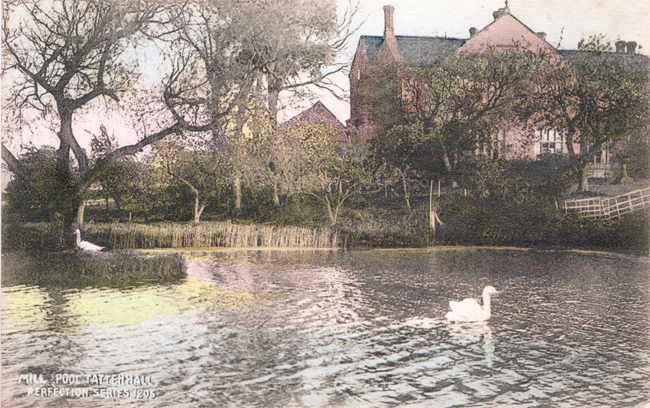
Perfection Series Postcard of Tattenhall Hall and Mill Pond
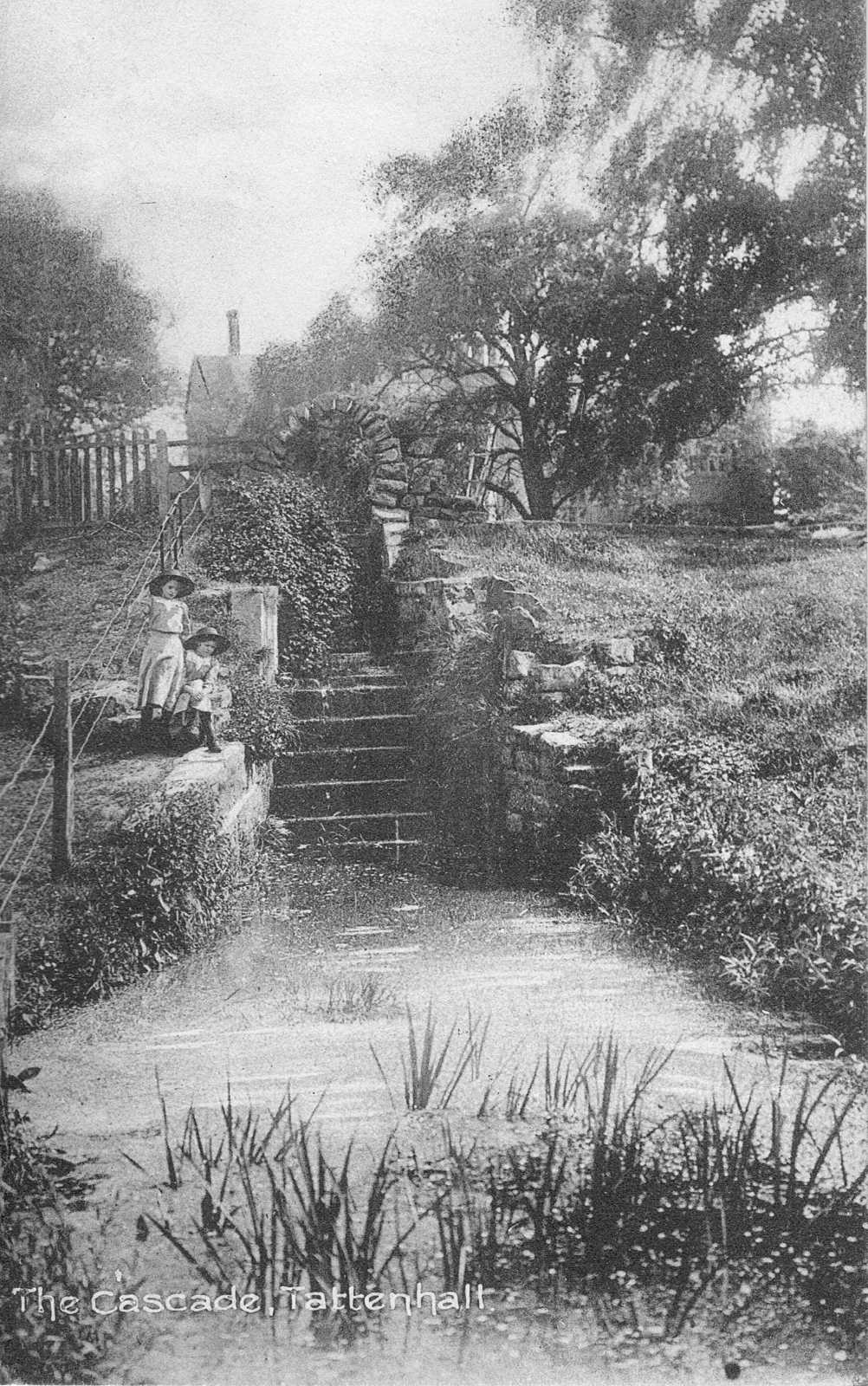
‘Cascade’ with Hall in background (click on image to enlarge)
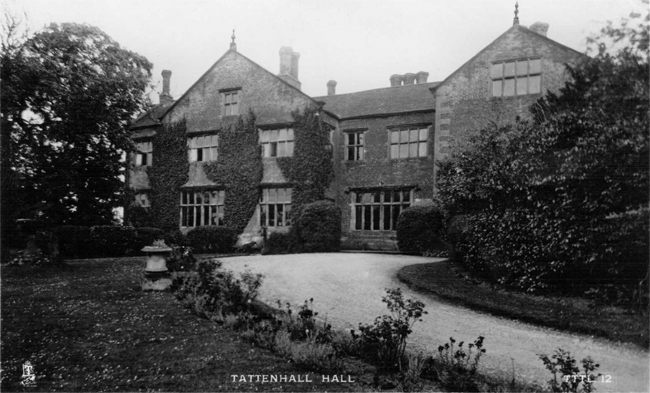
Front of the Hall with some formal hedging and planting
When the Barbour family purchased the Freehold Estate of 2,321 acres of fine land (now known as ‘Bolesworth Estate’) together with the Manors or Reputed Manors of Harthill, Chowley, Tattenhall and Burwardsley (and associated townships) at auction on 23 October 1856, ‘Tattenhall Hall’ was listed as follows:
‘This House is very large and substantially built in the Elizabethan style, with large windows and heavy stone mullions. It is roofed with slates and contains some large rooms. The farm buildings comprise Cow-houses for 48 cows, Wainhouse, Stable for 4 horses, Barn with threshing floor and three bays. Hay Bays and Cart Stable, Dove Cot or Pigeon–house and ranges of Pigs’ Cots and other outbuildings. There is also a brick-built and slated Corn Mill, the water-wheel of wood, and drives three pairs of stones. Great alterations have been made in the fences upon this farm and much of the land has been thoroughly drained; many of the fields have been manured with bones and some have been sub-soiled’.
The ‘Names of the Pieces’ (which in total comprised over 321 acres) and their ‘State of Cultivation’ were listed as follows:
Late Flacker* Field and others – Grass
Kinsey’s Moor, next the Mill – Arable
House, Garden, Fold, Yard, Outbuildings, etc. – Garden, etc.
Croft – Arable
Road from Fold Yard, etc. – Road
Far Part of the Wicket – Arable
Near Part of the Wicket – Arable
Birch Tree Bank – Grass
Mill Pond, Mill and Road adjoining – Water
Flacker Field Bottom – Grass
Little Meadow – Grass
Big Field – Grass
Town Field – Grass
China Meadow and Long Meadow – Grass
Bream Pit Field and parts of others – Arable
Lower Rough Hey – Grass
Allery Field – Arable
Brick-kiln Croft and others – Grass
Late part of Gorsty Croft – Grass
Little and Big Old Fields – Grass
Long Meadow – Grass
Long Field – Grass
Barrow’s Faugh – Grass
Pingle – Grass
Black Field – Arable
Shoelack Piece and others – Arable
Higher Rough Hey – Grass
Part of the Five Acres – Arable
The Six Acres – Arable
Thistley Field – Grass
*Flacker correctly spelt – now spelt as ‘Flacca’
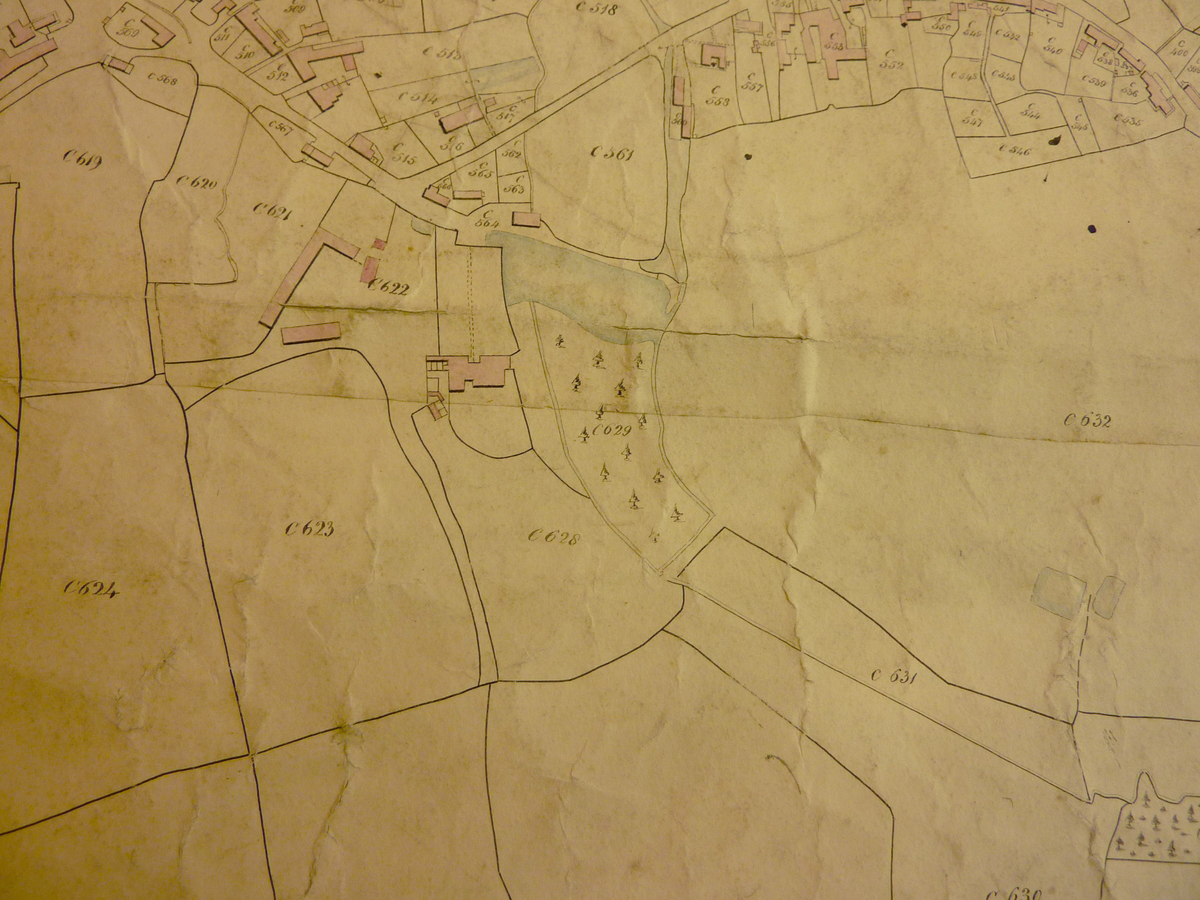
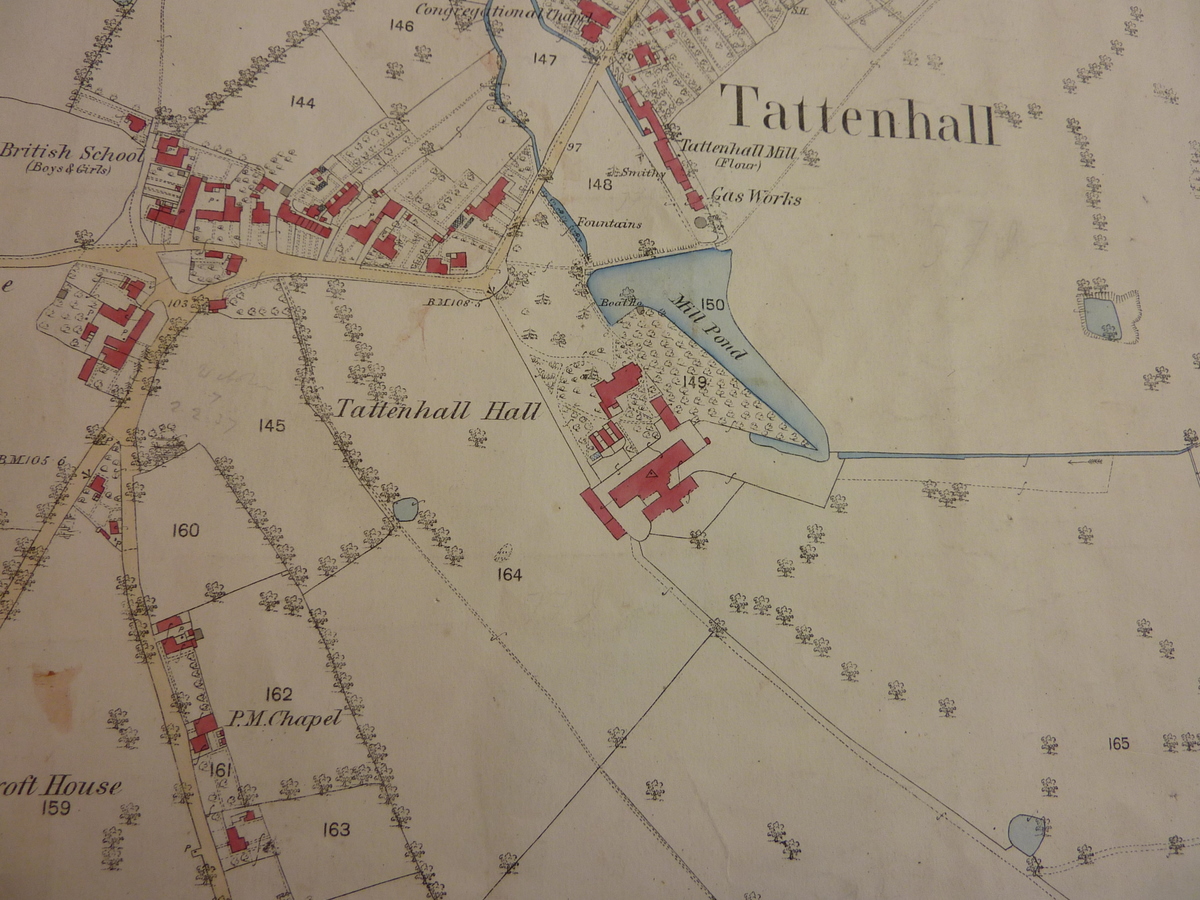
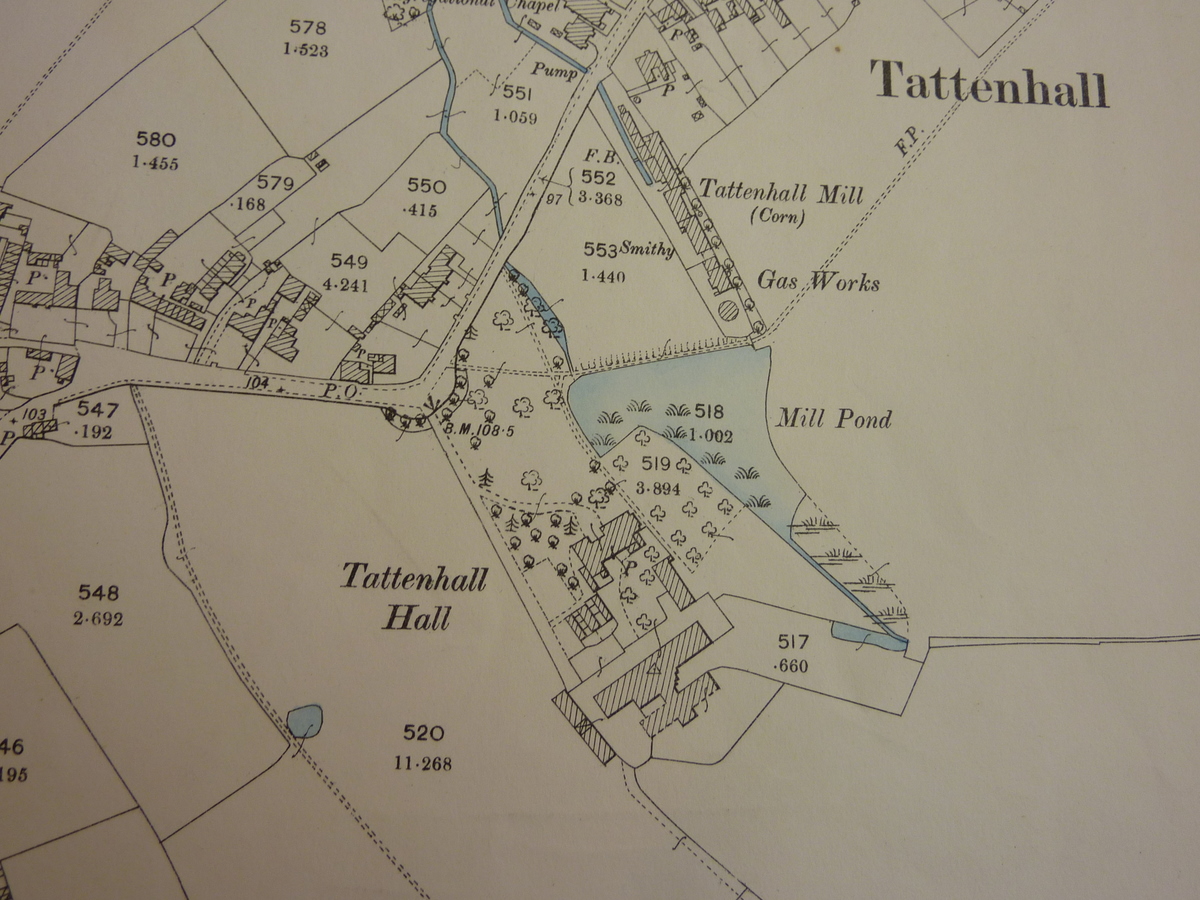
A series of maps below indicate the changing nature of the landscape adjacent to the Hall.
Map 1. (note Primitive Methodist Chapel, Congregational Chapel, British School for Boys and Girls, Tattenhall Hall, Mill Pond, Boat House and ‘Fountains’, Tattenhall Mill for flour, Smithy and Gas Works)
Map 2. (note Chapel, Pump, Smithy, Gas Works, Tattenhall Mill for Corn, Tattenhall Hall and Mill Pond)
Map 3. (Tithe Map indicating the Hall and Mill Pond)